
Did you know that mastering the time and work formula with shortcut tricks and examples can dramatically cut down the time it takes to solve complex quantitative aptitude problems, potentially boosting your competitive exam scores by 10-15%? Many students struggle with these concepts, often wasting precious minutes on convoluted calculations. This comprehensive guide, crafted for 2026 exam aspirants and efficiency enthusiasts alike, aims to demystify these crucial mathematical principles, offering clear explanations and actionable strategies to help you tackle any time and work problem with confidence and speed. We’ll explore foundational formulas, advanced techniques, and smart shortcuts that will transform your approach to these challenging questions.
The core time and work formula states that Work = Rate × Time, where ‘Rate’ refers to the efficiency of an individual or a group. Shortcut tricks often involve using the Least Common Multiple (LCM) method to find total work, or applying proportional reasoning to quickly determine combined or individual work completion times, significantly simplifying complex problems.
Understanding the Core Principles
At its heart, time and work problems revolve around the fundamental relationship between the amount of work done, the time taken to complete it, and the efficiency of the worker(s). Efficiency is simply the amount of work an individual can complete in a unit of time. If a person completes a task faster, they are considered more efficient. This inverse relationship is critical: more efficiency means less time to complete the same amount of work, and vice-versa. Grasping this basic concept is the first step towards mastering all variations of these problems.
Related Posts
To elaborate, consider a task where ‘W’ represents the total work, ‘T’ is the time taken, and ‘E’ is the efficiency (or rate) of work. The fundamental equation derived is W = E × T. From this, we can deduce E = W/T or T = W/E. Most problems assume the total work to be a single unit (e.g., building one wall, completing one report), but understanding that work can be any quantifiable task is essential. Recognizing these relationships allows for a flexible approach to problem-solving, setting the stage for more advanced shortcut applications.
Essential Time and Work Formulas
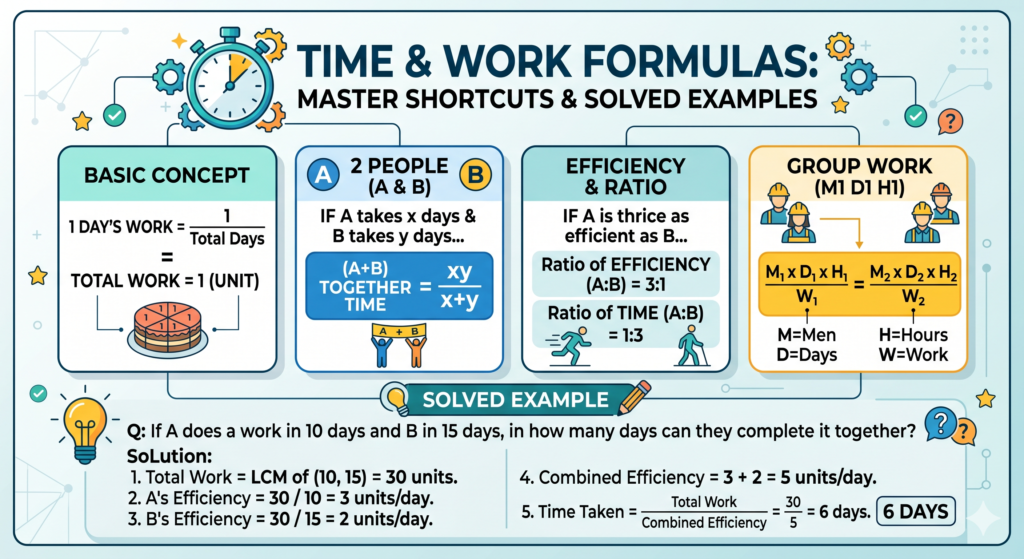
The basic time and work formula forms the foundation, but several extensions are vital for solving different problem types. When multiple individuals work together, their individual efficiencies add up to form a combined efficiency. For instance, if Person A completes a task in ‘a’ days and Person B in ‘b’ days, their combined work rate per day is (1/a + 1/b). The total time they take together is the reciprocal of this sum, i.e., 1 / (1/a + 1/b). This additive property of rates is a cornerstone for group work calculations.
Another crucial concept is the inverse proportionality between time and efficiency. If two individuals have efficiencies in the ratio E1:E2, then the time they take to complete the same work will be in the ratio T1:T2 = 1/E1 : 1/E2, or E2:E1. Understanding this direct relationship helps in solving problems where efficiency ratios are given instead of individual times. For a deeper dive into these quantitative aptitude concepts, you might find resources like Jagran Josh’s guide on time and work problems incredibly useful for comprehensive learning.
Shortcut Tricks for Rapid Problem Solving
One of the most powerful shortcut tricks for time and work problems is the LCM Method. Instead of dealing with fractions, assume the total work to be the Least Common Multiple (LCM) of the individual times taken. For example, if A takes 10 days and B takes 15 days, assume total work is LCM(10, 15) = 30 units. A’s efficiency is 30/10 = 3 units/day, and B’s is 30/15 = 2 units/day. Their combined efficiency is 3+2 = 5 units/day. The time taken together is 30/5 = 6 days. This method simplifies calculations significantly, making it ideal for competitive exams in 2026.
Man-Days Explained
The concept of “Man-Days” (or more broadly, “Worker-Units of Work”) is an extension of efficiency, particularly useful when the number of workers changes or the work involves a group. It states that Total Work = Number of Men × Number of Days × Efficiency per Man. If the efficiency per man is constant, then M1D1 = M2D2, where M is the number of men and D is the number of days. This formula is invaluable for problems like “If 10 men can complete a task in 20 days, how many men are needed to complete it in 5 days?” It allows for quick proportionality calculations without complex steps, assuming uniform efficiency.
Applying the Man-Days concept effectively requires careful attention to situations where efficiency might vary between individuals or groups. Sometimes, problems will specify that “3 men and 5 women can complete a task in X days.” In such cases, you must first establish a relationship between the efficiencies of men and women (e.g., 1 man’s work = 2 women’s work) to convert everything into a single unit (e.g., all men or all women) before applying the M1D1 = M2D2 principle. This conversion step is crucial for accurate and swift problem-solving.
Advanced Scenarios and Practical Applications
Beyond basic scenarios, time and work problems often introduce complexities like alternating work, negative work (e.g., leakages in pipes and cisterns), or varying efficiencies over time. For alternating work, where individuals work on different days, calculate the work done in one cycle (e.g., two days if A works day 1 and B works day 2) and then determine how many cycles are needed to complete the total work. This approach helps manage the sequential nature of tasks efficiently, preventing common errors.
Problems involving pipes and cisterns are essentially time and work problems in disguise, where pipes filling a tank are “positive work” and pipes emptying it are “negative work.” If pipe A fills a tank in ‘a’ hours and pipe B empties it in ‘b’ hours, their combined rate is (1/a
Khan Academy on work problems can provide additional exercises and explanations.
Mastering Through Practice and Analysis
The true mastery of the time and work formula with shortcut tricks and examples comes from consistent practice and post-analysis of solved problems. Don’t just solve; understand why a particular shortcut worked best for a specific problem type. Regularly reviewing your solutions helps in identifying patterns and solidifying your conceptual understanding. Try to solve problems using multiple methods (e.g., fractions and LCM) to see which is faster and more intuitive for you. This deliberate practice is key to developing speed and accuracy for upcoming challenges in 2026.
Furthermore, focus on understanding the underlying logic behind each formula and trick, rather than just memorizing them. When you comprehend the principles of efficiency, proportionality, and combined rates, you can adapt to novel problem variations that might not perfectly fit a predefined template. This analytical approach not only improves your problem-solving skills but also builds a strong foundation for other quantitative aptitude topics, making your learning highly transferable and effective.
Key Takeaways
- The core formula Work = Rate × Time is the foundation for all time and work problems.
- The LCM method simplifies calculations by converting fractional work rates into whole units.
- Man-Days (M1D1 = M2D2) is a powerful shortcut for problems involving changing numbers of workers.
- Practice with a focus on understanding the underlying logic, not just memorization, to tackle advanced scenarios like alternating work or negative work effectively.
Frequently Asked Questions
What is the basic time and work formula?
The most fundamental time and work formula is Work = Efficiency × Time. This means the total amount of work done is directly proportional to the rate at which work is performed (efficiency) and the duration for which it is performed (time).
How do you solve alternating work problems quickly?
For alternating work problems, calculate the total work done in one complete cycle (e.g., if A works day 1 and B works day 2, find work done in 2 days). Then, divide the total work by the work done per cycle to find the number of cycles, adjusting for any remaining work at the end of the last full cycle.
What is efficiency in time and work?
Efficiency in time and work refers to the amount of work an individual or a group can complete in a unit of time. It is inversely proportional to the time taken to complete a fixed amount of work; higher efficiency means less time, and lower efficiency means more time.
Why is the LCM method useful for time and work problems?
The LCM (Least Common Multiple) method is useful because it allows you to assume a total work unit that is easily divisible by the individual times taken by workers, thus converting fractional work rates into whole numbers. This significantly simplifies calculations and reduces the chances of errors, especially in timed exams.
Conclusion
Mastering the time and work formula with shortcut tricks and examples is an invaluable skill for anyone facing competitive examinations or simply looking to enhance their problem-solving abilities. By understanding the core principles, embracing the LCM and Man-Days methods, and consistently practicing, you can approach even the most daunting problems with confidence. Remember, the goal isn’t just to find the answer, but to find it accurately and efficiently. Keep practicing, stay sharp, and you’ll be well-prepared for any challenge that comes your way, certainly by 2026 and beyond. Share your favorite shortcut or a challenging problem you conquered in the comments below!