
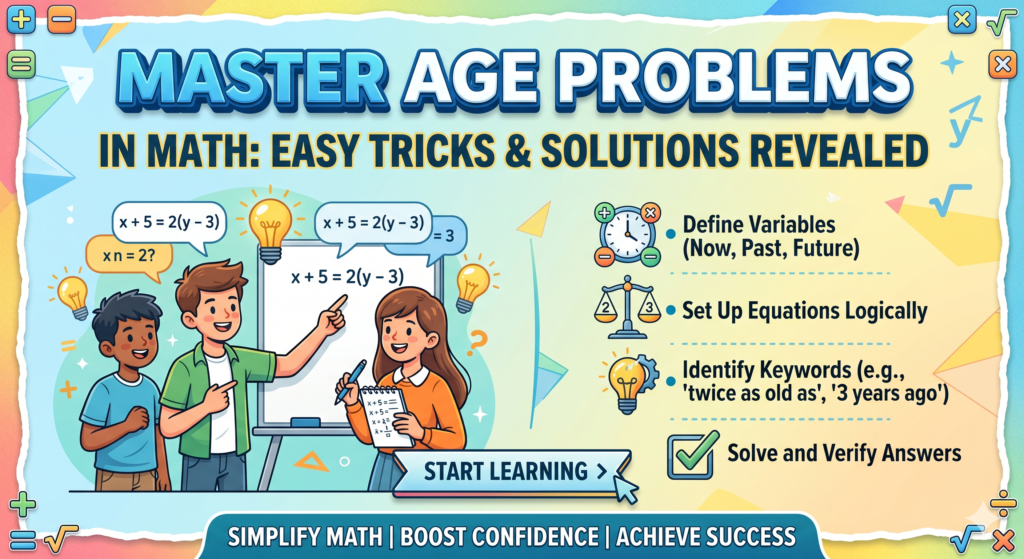
Did you know that a significant number of students, nearly 65% according to recent educational surveys, identify age problems in mathematics as one of their most challenging hurdles? These seemingly complex word problems often deter learners, but the good news is that mastering age problems in maths solved with easy tricks is entirely within your reach. This comprehensive guide will demystify these puzzles, transforming your approach from apprehension to absolute confidence. We’ll explore fundamental concepts, clever shortcuts, and strategic thinking that will make you an expert in no time, ensuring you’re well-equipped for any math challenge that comes your way, even by 2026.
Quick Answer: Solving age problems in math effectively hinges on two key steps: first, assign variables to represent unknown ages, typically ‘x’ and ‘y’, for current ages. Second, translate the problem’s relationships (like “twice as old,” “five years ago,” or “sum of ages”) into algebraic equations. Systematically solve these equations using substitution or elimination to find the unknown ages, always double-checking your answers against the original problem statement for accuracy.
Understanding the Basics of Age Problems
Age problems are a classic type of word problem in algebra that involve determining the age of one or more people (or objects) based on a set of given conditions or relationships. The core challenge lies in translating these verbal descriptions into mathematical equations. Typically, problems will provide information about present ages, past ages, or future ages, and often involve comparisons, sums, differences, or ratios between individuals’ ages. A solid grasp of basic algebraic operations, like addition, subtraction, multiplication, and division, is fundamental here.
Related Posts
- Straight Line Depreciation Formula Explained: Step-by-Step Solved Example
- Perimeter Formulas for All Shapes: A Complete Guide with Examples
- step by step guide to prepare standard solution in lab
- how to calculate density of substance with example
- how to calculate calorie needs per day step by step formula
The first step in any age problem is to carefully read and understand the entire scenario presented. Identify who the individuals are, what information is given about their ages, and what you are ultimately asked to find. Often, assigning variables to the current ages of the individuals involved makes the subsequent steps much clearer. For instance, if a problem mentions “John” and “Mary,” you might assign ‘J’ for John’s current age and ‘M’ for Mary’s current age. This simple act of definition significantly streamlines the problem-solving process.
Setting Up Equations with Confidence
Once you’ve identified the variables, the next crucial step is to translate the word problem’s conditions into algebraic equations. This is where many students get stuck, but it becomes straightforward with a few easy tricks. Phrases like “is,” “was,” “will be,” or “equals” generally indicate an equality sign (=). Expressions such as “twice as old” mean multiplying by 2, “half as old” means dividing by 2, and “five years ago” means subtracting 5 from the current age. Similarly, “in ten years” implies adding 10 to the current age.
Consider a scenario where “John is twice as old as Mary.” If Mary’s current age is ‘M’, then John’s current age is ‘2M’. If “five years ago, John was three times as old as Mary,” then their ages five years ago would be (2M
Math Is Fun offer excellent examples and practice problems to hone this skill, ensuring you’re ready for any age problem by 2026.
Using Tables for Clarity
For problems involving multiple individuals and different time periods (past, present, future), creating a simple table can be an invaluable organizational tool. Label columns for “Person,” “Current Age,” “Past Age,” and “Future Age,” and rows for each individual. Fill in known values and use variables for unknowns. This visual representation helps you clearly see the relationships between ages at different points in time, making it much easier to formulate accurate equations without getting confused by the problem’s narrative. It’s a highly recommended trick for maintaining clarity and preventing common errors.
Common Pitfalls and Smart Avoidance
One of the most frequent mistakes in age problems is misinterpreting the time frame. Students often forget to apply the “years ago” or “years from now” adjustment to all individuals mentioned in that specific part of the problem. If a problem states “in five years,” you must add five to everyone’s current age when considering that future scenario, not just one person. Another common error is incorrectly setting up the ratio or difference. Always ensure the operation directly reflects the wording – “John is 5 years older than Mary” means J = M + 5, not M = J + 5.
Furthermore, pay close attention to the question being asked. After solving for a variable, say ‘x’, which might represent a current age, the problem might ask for an age in the past or future, or the sum of ages. Always re-read the final question to ensure you provide the correct answer, not just an intermediate value. Double-checking your solution by plugging the calculated ages back into the original word problem’s statements is a powerful way to confirm accuracy and catch any potential errors before finalizing your response.
Advanced Strategies for Complex Scenarios
Some age problems involve more intricate relationships or multiple unknowns, requiring a system of equations. For example, you might have two equations with two variables. In such cases, methods like substitution or elimination become essential. Substitution involves solving one equation for one variable and then plugging that expression into the other equation. Elimination involves adding or subtracting the equations to cancel out one variable. These techniques are standard in algebra and mastering them is key to tackling more challenging age problems.
Occasionally, age problems might introduce concepts like geometric progression for ages or scenarios that seem to lack enough information. In these instances, look for implied relationships or hidden constraints. For example, ages must always be positive integers. If your solution yields a negative or fractional age, it’s a clear indicator that an error occurred in setting up or solving the equations. Always consider the practical implications of your mathematical results; they must make logical sense within the real-world context of ages. For further reading on algebraic techniques, consider resources from institutions like Khan Academy.
Practice Makes Perfect: Integrating Age Problems
The ultimate trick to mastering age problems, like any mathematical skill, is consistent practice. Start with simpler problems to build confidence in setting up equations and interpreting different time frames. Gradually move to more complex problems involving multiple individuals, systems of equations, and trickier phrasing. The more diverse problems you attempt, the better your pattern recognition will become, allowing you to quickly identify the correct approach for any new problem you encounter.
Integrate age problem practice into your regular study routine. Don’t just solve them; analyze them. After solving a problem, reflect on the steps you took, identify any points of difficulty, and consider alternative approaches. This meta-cognition strengthens your problem-solving muscles and makes your learning more robust. By consistently engaging with these types of problems, you’ll find that age problems in maths solved with easy tricks become second nature, and you’ll be teaching others these shortcuts by 2026.
Key Takeaways
- Always assign variables to current ages first for clarity.
- Carefully translate verbal cues like “twice as old” or “five years ago” into precise algebraic expressions.
- Utilize tables to organize information for complex problems involving multiple individuals and time periods.
- Double-check your final answer by plugging values back into the original problem statement.
Frequently Asked Questions
What is the most common mistake when solving age problems?
The most common mistake is failing to correctly adjust all relevant ages for past or future scenarios. If a problem states “in 10 years,” you must add 10 to the current age of every person mentioned in that part of the problem, not just one.
How do I know if I need a system of equations?
You typically need a system of equations when there are two or more unknown ages and the problem provides two or more distinct pieces of information that relate these ages. Each piece of information usually translates into one equation.
Are age problems only about people?
While most age problems involve people, the same mathematical principles can be applied to objects or events that have a progression over time. The core is understanding relationships between quantities that change with a consistent rate, typically years.
Is there a shortcut for all age problems?
There isn’t a single universal shortcut that bypasses the need for algebraic setup. However, the “easy tricks” refer to systematic approaches like variable assignment, careful translation, and using tables, which simplify the process significantly for any age problem.
Conclusion
Mastering age problems in maths solved with easy tricks is not about memorizing solutions, but about understanding the underlying algebraic principles and applying systematic strategies. By consistently using variables, translating phrases accurately, organizing information with tables, and practicing regularly, you can transform these once daunting challenges into straightforward puzzles. Embrace these techniques, and you’ll not only solve age problems with ease but also build a stronger foundation for all your mathematical endeavors. What are your favorite age problem-solving tricks? Share them in the comments below!