
Converting time zones manually without a calculator might sound like a relic from the pre-digital age, but it’s a skill that still saves travelers, remote workers, and global teams from scheduling disasters. Whether you’re coordinating a Zoom call with colleagues in Tokyo, planning a flight that lands in a different hemisphere, or simply trying to avoid waking your cousin in Sydney at 3 AM, understanding how to adjust for time differences without relying on apps is empowering. The process isn’t just about memorizing offsets—it’s about developing an intuitive grasp of Earth’s rotation, the 24-hour clock, and the quirks of daylight saving time. Master this, and you’ll never be at the mercy of a dead phone battery or a spotty Wi-Fi signal again.
What Is Time Zone Conversion Without a Calculator?
Time zone conversion without a calculator means adjusting clock times between regions using mental math, reference points, and simple arithmetic instead of digital tools. At its core, it relies on knowing the UTC offset (how many hours a location is ahead or behind Coordinated Universal Time) and applying basic addition or subtraction. For example, if New York is UTC-5 and London is UTC+0, you can determine that London is 5 hours ahead by subtracting the offsets. This method becomes second nature with practice, turning what seems like a complex puzzle into a straightforward habit.
Beyond the basics, manual conversion also involves accounting for daylight saving time (DST), which shifts clocks forward or backward in many countries. A location’s UTC offset can change depending on the season, so staying aware of these adjustments is crucial. The key is to break the process into manageable steps: identify the time zones involved, note their offsets, adjust for DST if necessary, and then perform the math. With a few tricks—like using the 24-hour clock to avoid AM/PM confusion—you’ll convert times accurately every time.
Understanding the 24-Hour Clock for Simpler Math

The 24-hour clock, also known as military time, eliminates the ambiguity of AM and PM, making time zone conversions far easier. Instead of juggling two 12-hour cycles, you work with a single continuous scale from 00:00 (midnight) to 23:59. This system is especially useful when dealing with international schedules, where a meeting at “3 PM” in one country might be “15:00” in another. By converting all times to the 24-hour format first, you reduce the risk of errors caused by misinterpreting AM/PM.
For example, if you’re in Chicago (UTC-6) and need to call a client in Berlin (UTC+1) at 2 PM Berlin time, you’d first convert 2 PM to 14:00. Then, subtract the 7-hour difference (6 + 1) to find that 14:00 Berlin time is 7:00 AM in Chicago. No calculator needed—just a clear understanding of the 24-hour system. To practice, try converting your daily schedule to military time for a week. You’ll quickly notice how much smoother time zone math becomes.
Why AM/PM Confuses Time Zone Conversions
AM and PM can trip you up because they force you to track two separate 12-hour cycles, which is especially problematic when crossing midnight. Imagine you’re in Los Angeles (UTC-8) and need to know what time it is in Sydney (UTC+10) at 11 PM LA time. If you stick to AM/PM, you might mistakenly think 11 PM + 18 hours (the difference) is 5 PM the next day, when it’s actually 5 PM the same day. The 24-hour clock avoids this by treating time as a continuous line, so 23:00 + 18 hours = 17:00 (5 PM) the next day.
Another common pitfall is the “midnight confusion” when converting times near 12 AM. For instance, 12:30 AM in one time zone might be 12:30 PM in another, but if you’re not careful, you could mislabel it as 12:30 AM. The 24-hour clock clarifies this by representing midnight as 00:00 and noon as 12:00, removing any guesswork. If you’re new to this system, start by writing out the 24-hour equivalents of common times (e.g., 3 PM = 15:00) until it becomes automatic.
Practical Exercises to Master the 24-Hour Clock
To build confidence with the 24-hour clock, try these exercises. First, convert your daily routine: write down your wake-up time, lunch, and bedtime in both 12-hour and 24-hour formats. For example, 7:30 AM becomes 07:30, and 9:45 PM becomes 21:45. Next, practice adding and subtracting hours. If it’s 14:00 now, what time will it be in 5 hours? (Answer: 19:00.) What time was it 8 hours ago? (Answer: 06:00.)
For a real-world challenge, pick two cities with a significant time difference—like New York and Mumbai—and convert a series of times between them. Start with simple cases (e.g., 12:00 PM in New York to Mumbai time) and gradually tackle trickier ones (e.g., 11:30 PM in New York to Mumbai time, accounting for the date change). Use a time zone map to verify your answers. Over time, you’ll develop a mental shortcut for these calculations.
Memorizing Key UTC Offsets for Quick Reference
While you don’t need to memorize every UTC offset in the world, knowing a few major ones will speed up your manual conversions. Start with the time zones of cities you interact with frequently. For example, New York is UTC-5 (or UTC-4 during daylight saving), London is UTC+0 (or UTC+1 in summer), and Tokyo is UTC+9 year-round. These reference points act as anchors, allowing you to calculate other time zones relative to them.
To make this easier, create a mental “cheat sheet” of the most common offsets. Here’s a quick list to get you started:
- UTC-8: Los Angeles (Pacific Time, UTC-7 during DST)
- UTC-5: New York (Eastern Time, UTC-4 during DST)
- UTC+0: London (Greenwich Mean Time, UTC+1 during DST)
- UTC+1: Paris, Berlin (Central European Time, UTC+2 during DST)
- UTC+8: Beijing, Singapore (no DST)
- UTC+9: Tokyo (no DST)
- UTC+10: Sydney (UTC+11 during DST)
Once you’ve internalized these, you can estimate other time zones by comparing them to your known references. For example, if you know Moscow is UTC+3 and Dubai is UTC+4, you can deduce that Dubai is 1 hour ahead of Moscow without looking it up.
Using Landmarks to Remember Offsets
Associating time zones with landmarks or cultural references can make them stick in your memory. For instance, think of the Prime Meridian (0° longitude) running through Greenwich, England, which is why London is UTC+0. The International Date Line, roughly at 180° longitude, marks where the day changes—useful for remembering that locations like Fiji (UTC+12) are nearly a full day ahead of UTC-12 zones like Baker Island.
Another trick is to link time zones to major cities or events. For example, the Super Bowl is often at 6:30 PM Eastern Time (UTC-5), so if you’re in London (UTC+0), it’s 11:30 PM. The New Year’s Eve countdown in Sydney (UTC+10) happens 19 hours before New York’s (UTC-5), which is why Australians celebrate first. These real-world connections make offsets feel less abstract and more intuitive.
How Daylight Saving Time Affects Offsets
Daylight saving time (DST) complicates manual conversions because it temporarily changes a location’s UTC offset. In the Northern Hemisphere, clocks “spring forward” an hour in March or April and “fall back” in October or November. For example, New York shifts from UTC-5 to UTC-4 during DST, while London goes from UTC+0 to UTC+1. The Southern Hemisphere follows a reverse schedule, with countries like Australia and Chile observing DST during their summer (our winter).
To avoid mistakes, note whether DST is in effect for the time zones you’re converting. A quick way to remember is to associate DST with warmer months: if it’s summer in the Northern Hemisphere, most locations there will be on DST. For the Southern Hemisphere, DST aligns with their summer (our winter). If you’re unsure, check a DST calendar or use the mnemonic “spring forward, fall back” to recall the direction of the shift.
Step-by-Step Guide to Converting Time Zones Manually
Now that you understand the basics, let’s walk through a step-by-step method for converting time zones without a calculator. We’ll use a real-world example: you’re in Chicago (UTC-6, or UTC-5 during DST) and need to schedule a call with a team in Dubai (UTC+4, no DST) at 3 PM Dubai time. Here’s how to do it:
- Identify the time zones and their offsets: Chicago is UTC-6 (or UTC-5 if DST is active), and Dubai is UTC+4. For this example, let’s assume it’s winter, so Chicago is UTC-6.
- Calculate the total difference: Dubai is 10 hours ahead of Chicago (6 + 4).
- Convert the target time to 24-hour format: 3 PM Dubai time is 15:00.
- Subtract the difference to find Chicago time: 15:00
- 10 hours = 5:00 AM.
- Verify the date: Since 15:00 in Dubai is the same day as 5:00 AM in Chicago, no date adjustment is needed.
This method works for any two time zones. The key is to always subtract the smaller offset from the larger one to find the difference, then adjust the time accordingly. If the result crosses midnight, you’ll need to account for the date change—more on that in the next section.
Handling Date Changes When Crossing Midnight
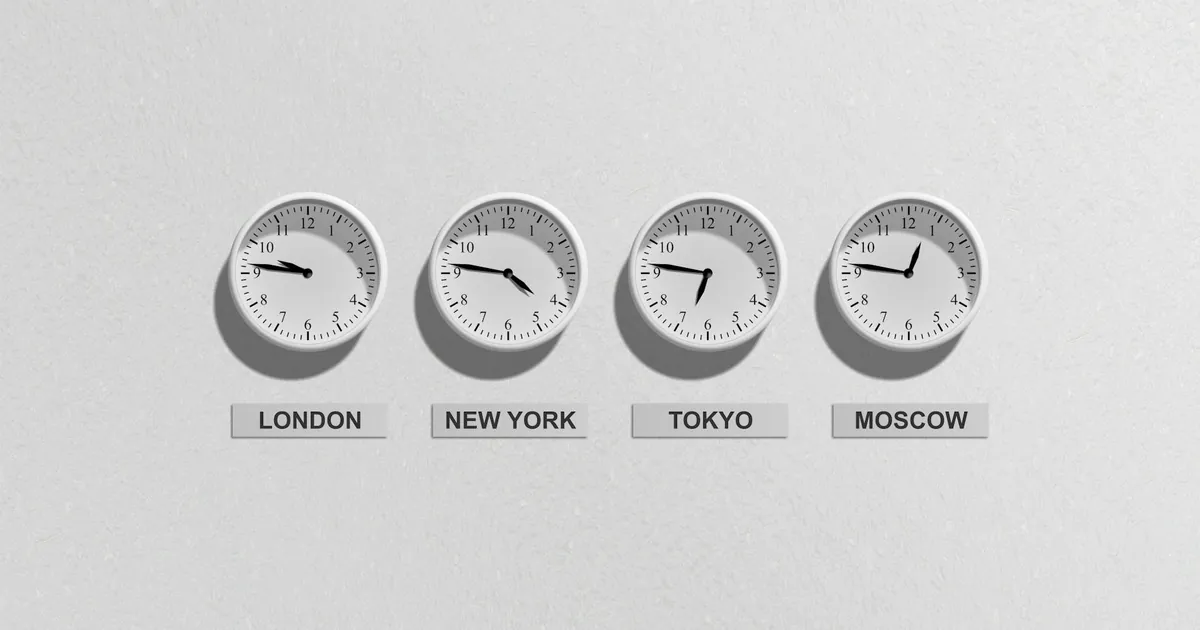
One of the trickiest parts of manual time zone conversion is dealing with date changes, especially when the time difference spans midnight. For example, if it’s 11 PM in New York (UTC-5) on Monday, what time is it in Tokyo (UTC+9)? The difference is 14 hours, so 23:00 + 14 hours = 13:00 (1 PM) on Tuesday. The date flips because you’ve crossed midnight.
To avoid confusion, break the calculation into two steps. First, add or subtract the hours until you reach midnight. In the New York-to-Tokyo example, 23:00 + 1 hour = 00:00 (midnight), leaving 13 hours remaining. Then, add the remaining hours to the new day: 00:00 + 13 hours = 13:00 on Tuesday. This “split” method ensures you don’t lose track of the date. Practice with extreme time differences, like converting 10 PM in Los Angeles to Sydney time (a 19-hour gap), to build confidence.
Double-Checking Your Work with Opposite Conversions
A foolproof way to verify your manual conversions is to reverse the calculation. Using the earlier Chicago-to-Dubai example, you determined that 3 PM Dubai time is 5 AM Chicago time. To check, convert 5 AM Chicago time back to Dubai time: 5:00 + 10 hours = 15:00 (3 PM). If the result matches the original time, your conversion is correct.
This technique is especially useful for complex conversions involving DST or date changes. For instance, if you’re converting 1 AM in London (UTC+0, no DST) to New York time (UTC-5), you’d subtract 5 hours to get 8 PM the previous day. To verify, add 5 hours to 8 PM New York time: 20:00 + 5 hours = 1:00 AM London time, confirming the calculation. This back-and-forth method trains your brain to spot errors and reinforces the logic behind time zone math.
Common Mistakes and How to Avoid Them
Even seasoned travelers and professionals make mistakes when converting time zones manually. The most frequent error is misapplying daylight saving time, leading to an hour’s discrepancy. For example, assuming London is always UTC+0 (it’s UTC+1 during DST) or forgetting that some countries, like Japan and India, don’t observe DST at all. To avoid this, always ask: “Is DST in effect for either location right now?” If you’re unsure, a quick mental check of the season can help—DST is active during summer months in most places.
Another common pitfall is mixing up the direction of the time difference. If you’re in a UTC-5 zone and converting to a UTC+3 zone, it’s easy to mistakenly add 8 hours instead of subtracting 8 hours (or vice versa). A simple rule of thumb is to remember that east is ahead and west is behind. If you’re moving eastward (e.g., from New York to London), the time increases; if you’re moving westward (e.g., from London to New York), the time decreases. Visualizing a map can help reinforce this.
Overlooking Half-Hour and Quarter-Hour Time Zones

Not all time zones are whole-hour offsets. Some, like India (UTC+5:30) and Nepal (UTC+5:45), have half-hour or even quarter-hour differences. These can throw off your calculations if you’re not expecting them. For example, if you’re in New York (UTC-5) and need to call someone in Mumbai (UTC+5:30), the difference isn’t 10 hours—it’s 10 hours and 30 minutes. To handle these, treat the minutes as a separate step. First, calculate the hour difference (10 hours), then add or subtract the minutes (30 minutes).
To practice, try converting 2 PM New York time to Mumbai time. The hour difference is 10 hours (14:00 + 10 = 00:00), and the 30-minute offset brings it to 00:30 (12:30 AM) the next day. These quirky time zones are less common, but they’re worth memorizing if you frequently deal with countries like India, Iran (UTC+3:30), or Australia’s Lord Howe Island (UTC+10:30).
Ignoring the International Date Line
The International Date Line (IDL), located roughly along the 180° meridian in the Pacific Ocean, is where the date changes. Crossing it can result in gaining or losing a full day, which is easy to overlook in manual conversions. For example, if it’s 10 AM on Monday in Tokyo (UTC+9), what time is it in Los Angeles (UTC-8)? The difference is 17 hours, so 10:00 + 17 hours = 3:00 AM on Tuesday. However, if you’re traveling westward across the IDL (e.g., from Tokyo to Los Angeles), you subtract a day; if traveling eastward (e.g., from Los Angeles to Tokyo), you add a day.
A quick way to remember this is to think of the IDL as a “date reset.” When you cross it moving west, you skip forward a day; when you cross it moving east, you go back a day. To avoid mistakes, always note whether your conversion crosses the IDL and adjust the date accordingly. For extreme cases, like converting between UTC+12 and UTC-12 (a 24-hour difference), the time stays the same, but the date changes by a full day.
Key Takeaways
- Convert all times to the 24-hour clock to eliminate AM/PM confusion and simplify math.
- Memorize key UTC offsets for major cities to use as reference points for other time zones.
- Always check if daylight saving time is in effect, as it temporarily changes UTC offsets.
- Break down conversions into steps: identify offsets, calculate the difference, adjust the time, and verify the date.
- Use the “east is ahead, west is behind” rule to determine whether to add or subtract hours.
- For half-hour or quarter-hour time zones, handle the hours and minutes separately to avoid errors.
- Double-check your work by reversing the conversion to ensure accuracy.
- Remember the International Date Line when converting between time zones on opposite sides of the world.
“Time zone conversion is less about memorization and more about developing a spatial awareness of the world. Once you visualize the Earth’s rotation and how time zones wrap around it, the math becomes intuitive. The real challenge isn’t the arithmetic—it’s accounting for the exceptions, like DST and half-hour offsets. Master those, and you’ll convert times faster than any app.”
—Dr. Emily Chen, Geophysicist and Time Zone Expert at the National Oceanic and Atmospheric Administration (NOAA)
Frequently Asked Questions
Why do some countries not observe daylight saving time?
Countries near the equator, like Singapore and Kenya, don’t observe daylight saving time because their daylight hours remain relatively consistent year-round. The energy-saving benefits of DST are minimal in these regions, so they stick to a single UTC offset. Additionally, some countries, like Japan and China, have abandoned DST due to public opposition or logistical challenges. For manual conversions, this means their time zones stay constant, simplifying calculations.
How do I convert time zones when traveling across multiple zones?
When traveling across multiple time zones, break the journey into segments. For example, if you’re flying from New York (UTC-5) to Dubai (UTC+4) via London (UTC+0), first convert New York time to London time (5-hour difference), then London time to Dubai time (4-hour difference). This step-by-step approach prevents overwhelm and reduces errors. Pro tip: Use the 24-hour clock to track your flight’s departure and arrival times, and note the local time at each layover to stay oriented.
What’s the easiest way to remember if a country is ahead or behind my time zone?
Use the “east is ahead, west is behind” rule. If a country is east of your location, its time is ahead; if it’s west, its time is behind. For example, London is east of New York, so it’s ahead (UTC+0 vs. UTC-5). To reinforce this, visualize a map with time zones radiating outward from the Prime Meridian. You can also use landmarks: the farther east you go (e.g., toward Asia), the later the time; the farther west (e.g., toward the Americas), the earlier the time.
How do I handle time zone conversions for virtual meetings?
For virtual meetings, start by identifying the time zone of the organizer or the majority of participants. Convert that time to your local time, then share the meeting link with the converted time clearly labeled (e.g., “3 PM EST / 8 PM GMT”). Tools like World Time Buddy can help, but practicing manual conversions ensures you’re never caught off guard. Always confirm the time with participants in different zones to avoid miscommunication.
Are there any apps or tools that can help me practice manual conversions?
Yes! While the goal is to convert time zones manually, apps like Time and Date’s Converter or Every Time Zone can help you practice. Use them to generate random conversion scenarios, then try solving them without the app. Over time, you’ll rely less on tools and more on your own skills. For a low-tech option, keep a notebook of common conversions and review them regularly.
What’s the best way to teach kids about time zone conversions?
Make it visual and interactive. Start by showing them a time zone map and explaining how the Earth’s rotation creates different times. Use a globe or a ball to demonstrate how the sun “moves” across time zones. Then, practice with fun scenarios, like calculating what time it is in Tokyo when it’s lunchtime in their hometown. Games like “time zone bingo,” where they match times to cities, can reinforce the concept. The key is to relate it to their daily lives—like when they can call a grandparent in another country.
How do time zones affect international business?
Time zones are a critical factor in global business, influencing everything from meeting schedules to project deadlines. Companies with teams in multiple time zones often adopt “overlap hours,” where all employees are online simultaneously, or rotate meeting times to share the inconvenience. For example, a team in San Francisco (UTC-8) and Sydney (UTC+10) might schedule meetings at 4 PM San Francisco time (10 AM Sydney time) to accommodate both. Misjudging time zones can lead to missed calls, delayed responses, or even lost deals, which is why manual conversion skills are invaluable in international roles.
Mastering time zone conversions without a calculator isn’t just a party trick—it’s a practical skill that saves time, reduces stress, and keeps you connected in an increasingly global world. Start with the basics, practice regularly, and soon you’ll be converting times as effortlessly as checking the weather. The next time someone asks, “What time is it there?” you’ll have the answer at your fingertips—no battery required.